
Colloquium: Every State, Every Day: Estimands for Ordinal Longitudinal Outcomes
Dr. Thomas Stewart, University of Virginia
11 AM in the Z. Smith Reynolds (ZSR) Auditorium, Room 404
For the comfort of all, please refrain from wearing scented products. Thank you!
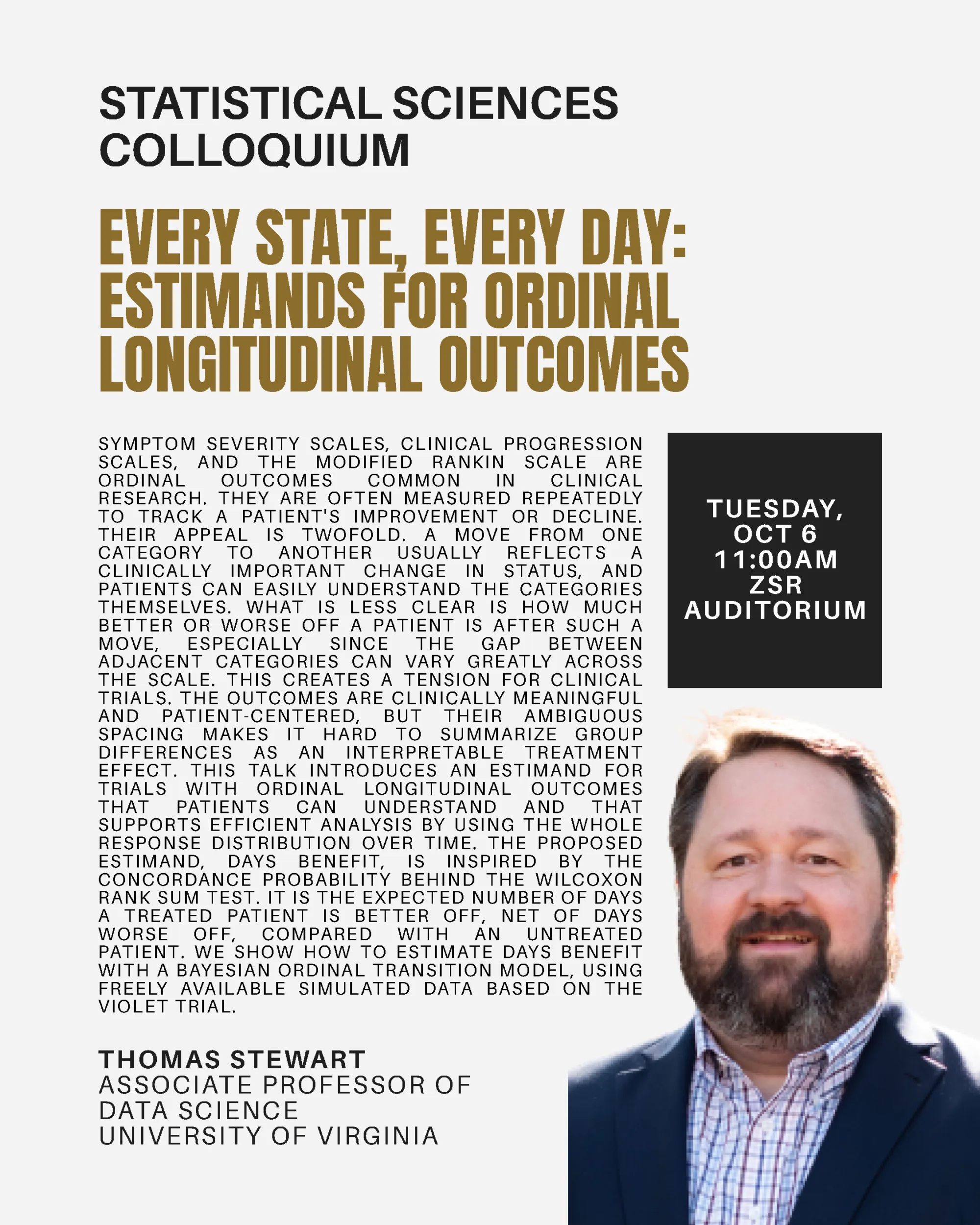
Symptom severity scales, clinical progression scales, and the modified Rankin Scale are ordinal outcomes common in clinical research. They are often measured repeatedly to track a patient’s improvement or decline. Their appeal is twofold. A move from one category to another usually reflects a clinically important change in status, and patients can easily understand the categories themselves. What is less clear is how much better or worse off a patient is after such a move, especially since the gap between adjacent categories can vary greatly across the scale. This creates a tension for clinical trials. The outcomes are clinically meaningful and patient-centered, but their ambiguous spacing makes it hard to summarize group differences as an interpretable treatment effect. This talk introduces an estimand for trials with ordinal longitudinal outcomes that patients can understand and that supports efficient analysis by using the whole response distribution over time. The proposed estimand, days benefit, is inspired by the concordance probability behind the Wilcoxon rank sum test. It is the expected number of days a treated patient is better off, net of days worse off, compared with an untreated patient. We show how to estimate days benefit with a Bayesian ordinal transition model, using freely available simulated data based on the VIOLET trial.
Thomas Stewart is a data scientist specializing in biostatistics, clinical trials, and clinical research education. He serves as lead statistician for two NIH-funded, multi-site clinical trials: Pass It On investigates convalescent plasma as a treatment for patients hospitalized with COVID19, and ACTIV-6 is a platform trial investigating repurposed medications like Ivermectin, Fluvoxamine, and Fluticasone for mild to moderate COVID19.
Prior to joining the University of Virginia’s School of Data Science as an associate professor, Stewart was faculty at the Vanderbilt University Medical Center where he taught in the Data Science Institute, the Clinical Investigation program, and the Public Health program. At the national level, Stewart served as a founding board member for Biostats4You, a continuously curated website of educational materials sponsored by the Biostatistics, Epidemiology and Research Design Special Interest Group of the Association for Clinical and Translational Science. In 2022, he was elected to the Academy for Excellence in Education.
Stewart is a highly collaborative data scientist, including past collaborations with ACHQC, VCKD, and VICTR. He was an organizer of useR! 2022, the international conference for statistical computing and graphics with the R software.
Stewart holds a Ph.D. in Biostatistics from the University of North Carolina at Chapel Hill and an M.S. in Statistics, a B.S. Mathematics, and B.A. Economics from Brigham Young University.